

SPONSORED
Keep Emergency Communications Out of the Dead Zone
Emergency Responder Communication Enhancements Solutions (ERCES) for Commercial Buildings
By Honeywell Fire Solutions | February 23, 2023
Read Time: 5 Minutes

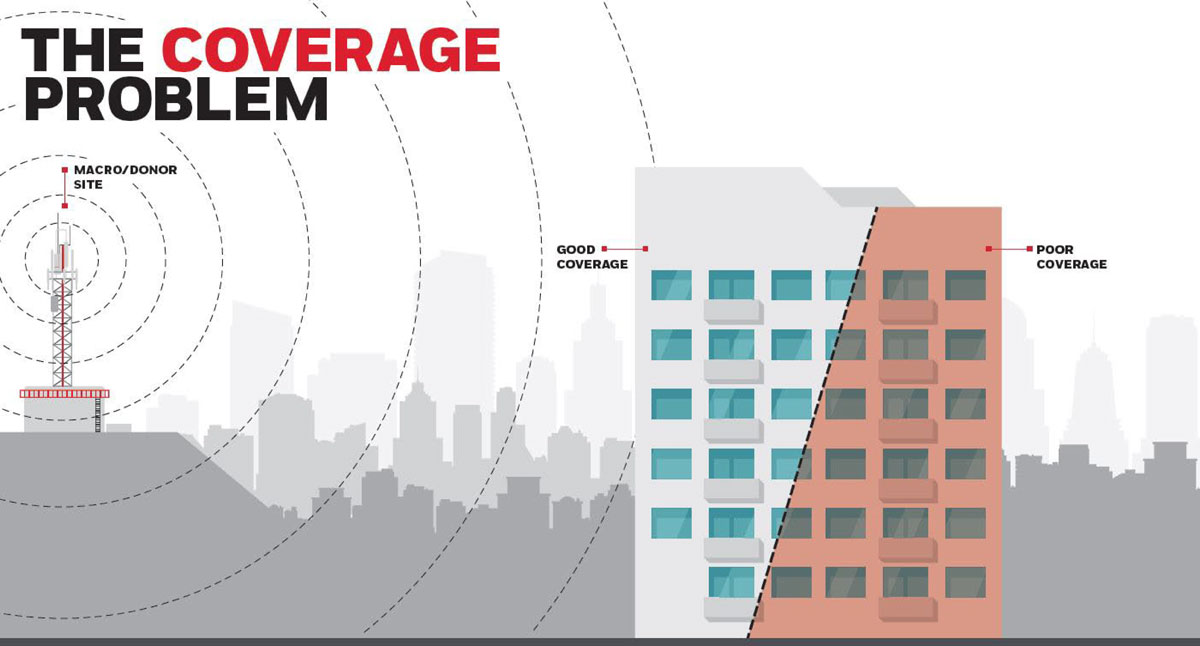
The Coverage Problem
Every minute counts when it comes to helping save people and property during an emergency. First responders need to have clear and concise radio communication in all areas of a building – especially in spaces where signal can be lost. In many buildings, there are areas called “dead spots” that unintentionally minimize the radio signal strength, making it challenging for anyone to communicate effectively via radio. The signals may be obstructed by structures such as concrete, Low-E glass windows, metal, underground structures, and additional materials that impact the propagation of radio signals. In these dead spots, the signal is not strong enough to allow emergency communication hardware, such as two-way radios, to communicate with each other, negatively impacting first responders’ ability to communicate about and address emergency situations.
Code Requirements
To help address the coverage problem first responders face, Emergency Responder Communication Enhancements Solutions (ERCES) were first introduced in the 2009 International Building Code. The ERCES requirement was established to address the performance of emergency responders’ portable radios inside buildings because building construction, size, features, and other elements can absorb or block radio communications. Today's codes, like the IBC 2021 Section 916, NFPA 1 2021 Section 11.10, IFC 2021 Section 510, 2019 NFPA 1221 Section 9.6, or 2022 NFPA 1225 Chapter 18, require all buildings to have an approved level of in-building emergency communication coverage for emergency responders. This approved level of coverage is based on the existing coverage levels of the public safety communication systems of the jurisdiction at the exterior of the building.
Helping Solve the Coverage Problem
The code-required level of radio coverage can be achieved by enhancing the in-building radio frequency signal coverage with an ERCES system, also commonly referred to as a bi-directional amplifier (BDA) system. An ERCES/BDA system’s operation is straightforward: the radio signal from a responder’s two-way radio reaches an antenna inside a building. It is amplified both by other interior antennae for in-building communication, as well as an antenna on the roof, to facilitate external public safety radio system communications. The system is designed so radio signals from the public safety antenna reach first responders inside the building through the same method in reverse. These mechanisms all work together to enable first responders to have a clear, concise conversation when it matters most.
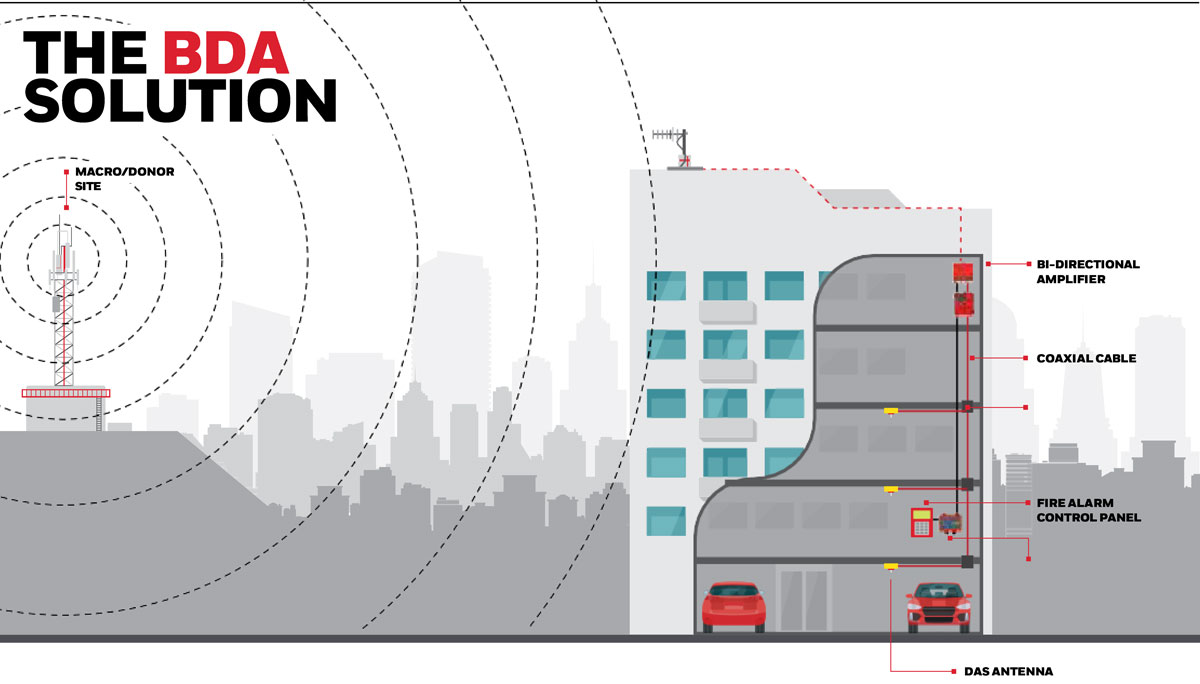
ERCES systems are comprised of a BDA, distributed antenna system (DAS), donor antenna, dedicated annunciator panel, and power components. The BDA serves as a signal-boosting device that sustains two-way communications and amplifies a signal while the DAS and donor antenna receive and transmit signals. BDAs work to both transmit and receive signals throughout a facility – including stairwells, underground tunnels, parking garages, and other challenging areas. The dedicated annunciator panel is required by code to display six potential trouble conditions. It will let the responder or facility manager know if there is an issue like a low battery or problems with the signal booster. The power supply includes a battery charging system to offer backup power if the building loses power during an emergency.
Fiplex by Honeywell BDA System: A Solution to the Coverage Problem
Specifically designed to meet NFPA and IBC/IFC code compliance, a Fiplex by Honeywell BDA system enhances two-way radio signal strength inside buildings, tunnels, and other structures and is an ideal solution to solve the coverage problem. A Fiplex BDA system offers a digital class A/B low to high power (0.5W to 5W) radio signal booster system that can be designed and customized to meet all public safety frequency band ranges: 700 MHz, 800 MHz, VHF, UHF, and FirstNet Band 14 support with single/dual band. Fiplex BDA solutions are developed to provide some of the best amplification and coverage performance and, at the same time, improve the reliability of the radio network with no noise. From software-defined configuration to innovative features that support mission-critical success, Fiplex BDAs are configurable to almost all jurisdictions, codes, and buildings.
Value of a Fiplex by Honeywell BDA System:
- Single portfolio offering all components required to meet any single or multi-building application across the United States supporting all public safety frequency bands
- IFC, IBC and NFPA compliant, FCC certified, and UL2524 2nd Edition listed
- Channel selective, software programmable or adjustable bandwidths
- Alarm relay outputs for fire alarm control panel connection for monitoring BDA remotely
- Dedicated annunciator options with built-in annunciator in battery backup unit and remote annunciator
- No-noise oscillation prevention and monitoring with programmable performance mitigation actions and automatic uplink power amplifier auto-off support for safe operation and non-interference with the public safety radio system
- Adaptable to multiple applications in different jurisdictions with a lower total cost of ownership
Conclusion
ERCES/BDA systems in emergencies help improve the signal in all areas of a building. With strong radio signal coverage, emergency officials can effectively communicate with each other in challenging circumstances. The state-of-the-art BDA system from Fiplex by Honeywell is an industry-leading, user-friendly, mission-critical solution offering flexibility to address multiple applications across different jurisdictions with a lower total cost of ownership. Fiplex by Honeywell BDA systems helps solve the coverage problem by enhancing the radio frequency coverage needed to keep first responders connected and protected so they can help save more lives.

ABOUT THE SPONSOR
This article was brought to you in partnership with Honeywell Fire Solutions.
Honeywell is uniquely positioned to blend physical products with software to support connected systems that improve homes, buildings, factories, utilities, vehicles, and aircraft, enabling a safer, more comfortable, and more productive world. Honeywell’s solutions enhance the quality of life of people around the globe and create new markets and industries..
You might also like
-
An Integrated Approach to Smart Technology is Critical August 21, 2023 The benefits of integrated technology in commercial buildings are clear and it’s important for you to think strategically about the current and future needs of tenants. The right approach to integration will ensure the current and future performance of your building, ultimately protecting your ...Sponsored
-
Why Retrofitting Your Building is a Smart Investment November 30, 2021 An investment-grade audit is the first step toward understanding why retrofitting is a smart investment. An audit gathers information about all aspects of your facility, including the age of current systems and what components or procedures are lacking. A comprehensive audit lays the groundwork fo...Article