
ARTICLE
Solving Data Center Development Challenges
Understanding the barriers to modern data center development.
By Rob Macchi | April 14, 2026
Read Time: 3 Minutes
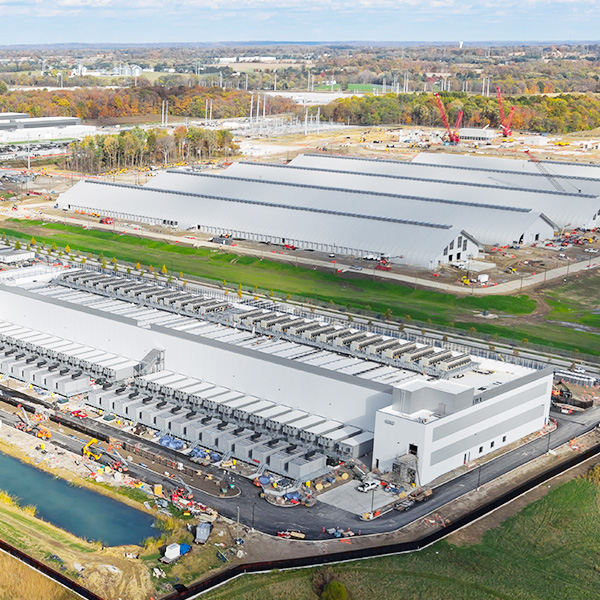
New data center development is booming globally, with nearly 100GW of new capacity expected to come online by 20301. AI is fueling demand for new, large-scale data centers and owners along with developers are building huge campuses to meet the demand for both AI and cloud computing workloads.
Data center developers face an array of challenges that can derail projects, not the least of which is the availability of adequate and reliable power delivery. Increasingly, data centers are looking to remote and rural markets for multi-gigawatt data center builds, but that introduces a new set of issues. Supply chain constraints and disruptions can also create headaches for developers, and many struggle to find the skilled workers they need in every market.
These challenges cause project delays and increase costs. Developers need strong partnerships to navigate this complexity and minimize financial risk.
1. Power Requirements
Beyond site selection, electrical power is the most critical requirement for any data center, and it’s increasingly hard to come by. Major grid operators such as PJM Interconnection (Mid-Atlantic/East Coast) and ERCOT (Texas) are saying they lack the capacity for more data centers2. Demand outpaces the construction of new power plants and transmission lines.
Many data center developers look to secondary or rural markets to find adequate power. However, even grid operator Southwest Power Pool in the Great Plains is looking to reduce demand due to increasing loads3.
Watchdogs are suggesting that data centers must build their own power generation, and a growing number are doing so. In a 2025 survey by Bloom Energy, 38 percent of data centers anticipate incorporating on-site power by 20304, with 27 percent aiming for full on-site power.
2. Supply Chain Challenges
Data center developers also face significant supply chain challenges. Power infrastructure is the biggest bottleneck, with substations and grid upgrades often taking longer than the data center build itself. Critical equipment such as generators and UPS systems often have 12 to 18-month waits.
Significant constraints persist in semiconductor availability due to massive demand and complex manufacturing with long lead times. Because semiconductor fabrication requires immense investment in highly specialized equipment, a few companies dominate the industry. Most advanced chips today are made outside North America.
Trade restrictions, export controls and geopolitical instability have disrupted supply chains, leading to a push for domestic production. However, semiconductor fabrication does not ramp up overnight. Plants funded by the 2022 CHIPS Act, for example, won’t come online until 2028.
3. Remote and Rural Markets
Data center developers often turn to remote and rural markets to take advantage of abundant, inexpensive land and gain access to power resources. Local governments may even lure developers with tax incentives, hoping to spur economic activity and create jobs.
Increasingly, however, developers are getting pushback from these communities. Projects often face political and public opposition over concerns about land use, noise pollution, rising electric bills and strain on water resources. Some states have proposed legislation requiring data centers to pay their fair share of infrastructure upgrades and even setting renewable energy goals.
Local governments may be unfamiliar with the unique requirements of data center projects, leading to zoning, permitting or environmental issues that are tricky to navigate. Remote locations can also exacerbate logistics and supply chain challenges.
4. Skilled Talent Shortages
Data center developers need access to specialized technical expertise for constructing, commissioning and operating data centers. The Uptime Institute projected a need for more than 325,000 new full-time data center jobs worldwide by the end of 20255.
The talent gap goes beyond the persistent shortage of IT workers. The real talent war is currently for electricians, plumbers, welders and HVAC technicians. According to the Bureau of Labor Statistics, demand for engineers specializing in power-distribution systems is rising at double the average rate for all occupations, with a projected 7 percent growth through 20336.
Hyperscalers and the AI Neo Cloud operators are increasingly building in remote or rural areas where local skilled labor is nonexistent, requiring extensive efforts to mobilize enough skilled workers. Developers are forced to import workers and incur higher recruitment costs.
How Wesco Can Help
Wesco can assist in virtually every aspect of data center design, development and operations. We are adept at project planning and coordination and managing global supply chains to avoid delays and disruptions. Wesco’s data center solutions teams can assist with complex projects, including site selection, power delivery and next generation infrastructure for AI.
We can respond rapidly to issues and deliver end-to-end solutions based on real-time needs, always keeping your budget and time-to-market requirements top of mind. Let us help you navigate the challenges of data center development and guide your project to completion.
1 https://www.jll.com/en-us/insights/market-outlook/data-center-outlook
2 https://www.reuters.com/markets/commodities/us-ai-boom-faces-electric-shock-2026-02-25/
3 https://www.utilitydive.com/news/spp-demand-response-prm-planning-reserve-transmission-rto-west/744455/
4 https://www.bloomenergy.com/news/onsite-generation-expected-to-fully-power-27-percent-of-data-center-facilities-by-2030/
5 https://intelligence.uptimeinstitute.com/resource/people-challenge-global-data-center-staffing-forecast-2021-2025
6 https://www.bls.gov/ooh/architecture-and-engineering/electrical-and-electronics-engineers.htm


ABOUT THE AUTHOR
Rob Macchi – Vice President AEC Construction, Channel & MTDC, Worldwide Accounts
Rob joined Wesco in 2013 and has held senior leadership roles across electrical construction, as well as Communications and Security Solutions (CSS). With over 35 years of experience in the industry, he now drives Wesco’s data center lifecycle solutions—from design to power, construction, procurement and on-site services.
You might also like
-
The Rise of “Construction-Ready” Supply Chains: A New Model for Data Center Build Speed May 11, 2026 In this EC&M feature, Wesco and Eaton share a new model for speeding data center builds by reducing risk and improving gray space execution.Article
-
Q1 Construction Industry Report — North Central March 23, 2026 Read the Q1 Construction Industry Report — North Central to learn the latest trends, challenges and growth opportunities for the region.Article
-
Q1 Construction Industry Report — West Great Lakes March 17, 2026 Read the Q1 Construction Industry Report — West Great Lakes to learn the latest trends, challenges and growth opportunities for the region.Article