
SPONSORED
AI Infusion: The Next Wave of Data Center Networking
By Leviton | September 26, 2024
Read Time: 3 Minutes

Investments in AI have skyrocketed, and AI computing clusters are at the front end of a huge ramp in growth. Industry analyst LightCounting expects a nearly 30% compound annual growth rate (CAGR) in fiber transceiver sales for AI clusters through 2028. However, data center managers face a range of challenges when deploying AI clusters, including power, cooling, geography, latency, and deployment speeds. These factors will ultimately drive the network architecture and type of cabling required throughout all types of data centers — from enterprise designs to large hyperscale builds.
Connectivity and Cabling for AI Networks
Climbing Data Rates
As you can imagine, AI is driving higher and higher data rates in data centers. Today, 200 Gb/s is most likely the slowest data rate in a large-scale AI cluster. In fact, 400 Gb/s and 800 Gb/s are more typical, and 1.6 Tb/s is expected to gain adoption in the near future.
Naturally, the physical interfaces of these data rates lead to different physical connectors and termination requirements. Connection choices at the higher data rates are largely driven by multi-source agreements (MSAs) between vendors, the most recent of which are the OSFP and QSFP-DD800 MSAs. Connection at the 400G data rate is dominated by traditional 12-fiber MPO connectors and LC connectors, with volume on the LC duplex FR4, and MPO-based DR4 and SR4 parallel optics. Additionally, at this rate, multimode interfaces will drive the adoption of angled physical contact (APC) to reduce reflectance or return loss. The angled end-face geometry improves return loss and performance, supporting higher data rates like 800G and beyond.
Cabling Connections
AI clusters consolidate a large number of fibers within racks and rows. From a cabling design perspective, one option for addressing such a high volume is to install direct connections from the AI systems to the switching fabric, using either active optical cables (AOCs) or discrete MPO array cords. This is the most straightforward approach, but it does create a significant volume of cable in the cable tray and within the racks themselves. Additionally, the QSFP (or OSFP) connector attached to the end of the AOC needs to be routed through the cable pathway. Pulling the transceivers through the pathways can be cumbersome, and the installer must be careful to avoid damage.
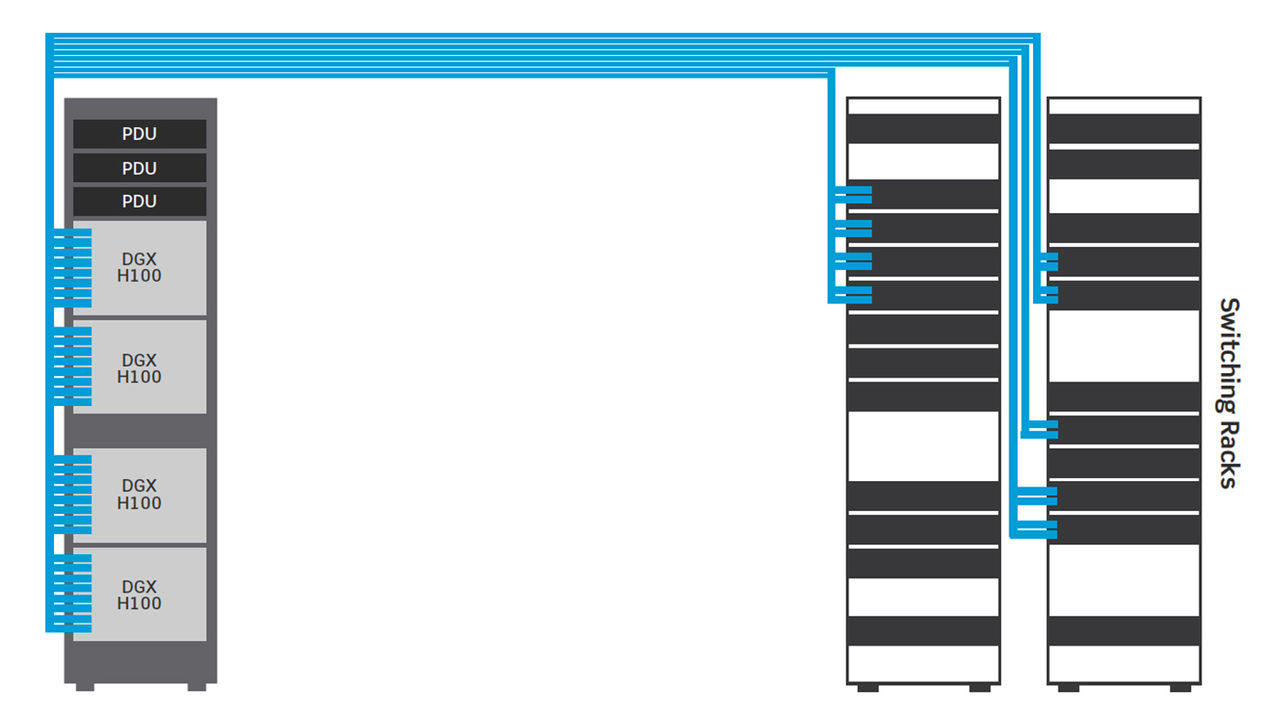 Port-to-port direct connection cabling, using NVIDI DGX H100 GPUs
If using a direct connect design, it is highly recommended to take steps to ensure the source and destination devices are known to help the installer. Very specific cable labeling is critical, and cable bundling or grouping is recommended.
As an alternative to direct connections, structured cabling offers significant benefits in AI clusters. This design replaces the vast number of point-to-point connections in the overhead tray with patch panels on either end, and higher fiber count MPO trunk cabling between the racks. The approach allows for smaller in-rack cables on the front side of patch panels, reducing congestion and improving cable density within the rack itself. These smaller diameter options in a structured cabling design can help improve airflow, contributing to greater overall efficiency in the rack.
Structured cabling also adds flexibility to help installers with cable management, offering panel labeling, easy cable grouping, and color coding of ports and connectors to make it easier to identify cables and reduce troubleshooting.
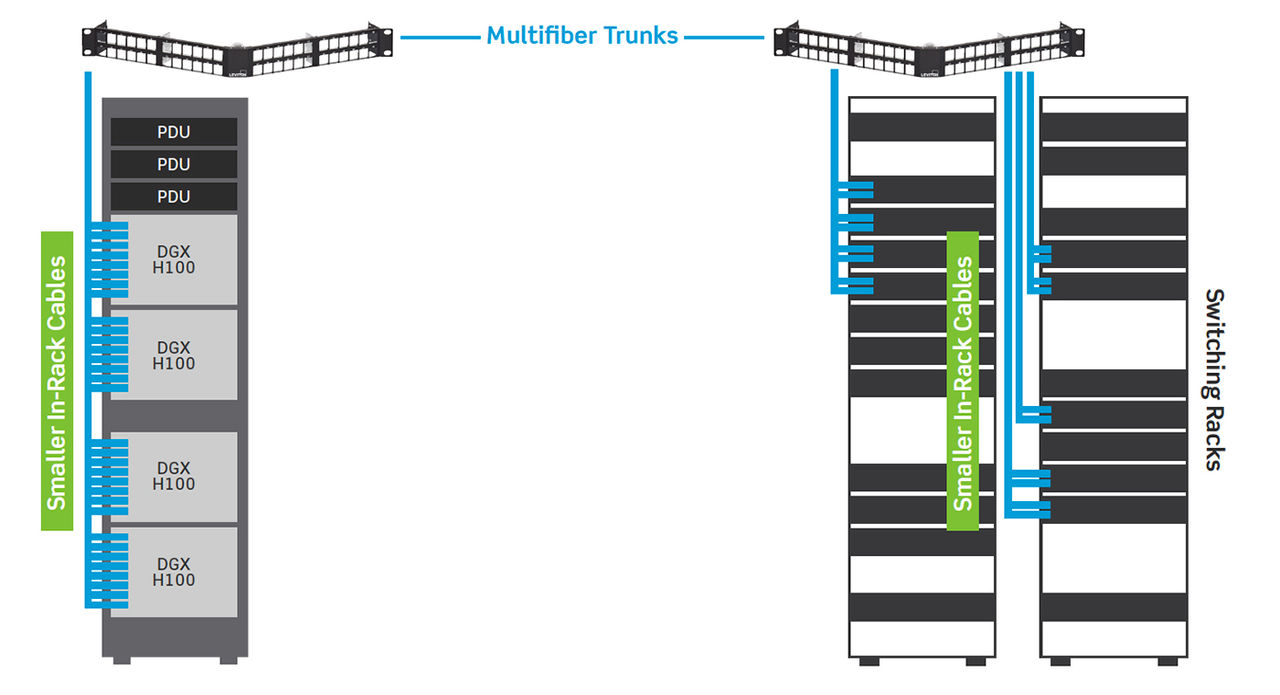 Structured Cabling Design
As latency is an important consideration in AI clusters, the question often arises as to which cabling method is best to address latency. With cabling, the key parameter for latency is not the physical optical connection but the overall length of the optical channel. As light passes through fiber, the latency is approximately 5 nanoseconds per meter, and properly designed structured cabling will not add additional latency compared to AOC or direct cabling connections.
A Flexible Solution for All Data Centers
Network managers need to consider the network architecture and cabling design for successful AI applications alongside data rates, scalability, latency, and power consumption. Structured cabling is an evolving and flexible solution to meet the needs of AI cluster deployments across all types of data centers.


ABOUT THE SPONSOR
This article was brought to you in partnership with Leviton.
For over a century, Leviton products have provided millions of users with the light, power, and information they need to move forward and do more every day. From electrical to lighting to networking, Leviton is engineering thoughtful solutions that help make life easier, safer, more efficient, and more productive.
You might also like
-
The Rise of “Construction-Ready” Supply Chains: A New Model for Data Center Build Speed May 11, 2026 In this EC&M feature, Wesco and Eaton share a new model for speeding data center builds by reducing risk and improving gray space execution.Article
-
Solving Data Center Development Challenges April 14, 2026 Discover key data center development challenges and how Wesco supports data center power requirements and supply chain considerations to keep projects on track.Article

-
Q1 Construction Industry Report — North Central March 23, 2026 Read the Q1 Construction Industry Report — North Central to learn the latest trends, challenges and growth opportunities for the region.Article