
SPONSORED
Extended Reach Cabling Solutions for Data Centers
By Leviton | November 11, 2025
Read Time: 5 Minutes

When addressing growing network demands, IT managers will often try to extend the reach of their infrastructure and maximize the life of their existing fiber cabling system. This approach can bring big benefits, but may also lead to concerns about the passive channel's bandwidth capabilities and attenuation loss in relation to the transceiver transmit power and receiver sensitivity. Let's take a closer look at extended reach considerations.
What Is Extended Reach?
Extended reach in data center cabling refers to infrastructure that exceeds the maximum length as defined by industry standards. It can also refer to a topology that incorporates additional connections, potentially exceeding channel loss limits of the target Ethernet or fiber channel application.
This can impact performance, especially as data rates and network demands increase. Understanding the proper installation specifications of extended reach cabling is essential for IT and network managers seeking scalable, cost-effective solutions.
What Drives Extended Reach Installations?
There are several reasons why data center managers might consider extended reach designs:
Legacy cabling infrastructure
Many organizations aim to reuse existing fiber cabling as a simple cost saving measure or due to an inability to replace or upgrade because of downtime or pathway issues. However, legacy infrastructure may not support higher data rates or new transceiver requirements without careful evaluation.
Technology upgrades: transceivers
With each technology refresh, there are often new industry standards to consider when mapping network improvements. If you’re evaluating whether to upgrade transceivers, it is crucial to confirm that existing cabling infrastructure can support new technology parameters and applications. As data rates have rapidly increased over the last few years, and with data centers deploying 400 Gb/s and above, compatibility between new transceivers and existing cabling is critical for reliable performance.
Extended Reach Example
Upgrading transceivers can change allowable lengths per industry standards.
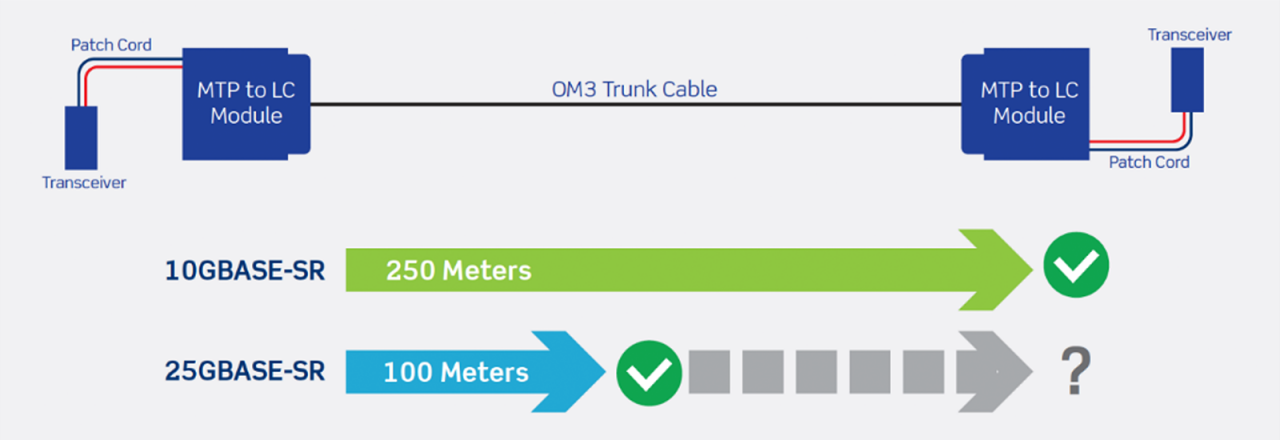
In a network that has a 250-meter OM3 trunk, moving from 10GBASE-SR transceivers (which support a standards-based operational length of 300 meters) to 25GBASE-SR transceivers would require verification that the new transceivers would still be supported over the legacy OM3 trunk, since their standard operational length limit drops to 100 meters.
Technology upgrades: hardware additions
Some technology updates add fiber optic components, such as cassettes, harnesses or adapter plates. This increases the number of physical matings within the channel, potentially exceeding industry standards for length limits and attenuation loss. Similarly, upgrading to higher fiber grades (OM4, OM5, OS2) may also introduce new patch points, which would require careful channel loss analysis.
Competitive product responses
Consultants and bidding contractors must validate that their proposed designs and product offerings will meet the performance requirements for the user’s specific distances, topologies or data rates.
Factors That Improve Extended Reach Capabilities
There are a range of influences that can limit extended reach, including the maximum performance loss of components, number of components or matings in the channel, fiber grades, transceiver choices, quality of the products used and installation practices.
To improve performance of extended reach infrastructure, consider the following factors:
Engineered links
While standards-based links set limits on maximum allowable loss in the channel, individual components and connector matings, custom engineered links allow additional matings or components that are evaluated to meet a target application.
Factory-controlled products
Products manufactured in controlled environments using commercial-grade assembly termination and test equipment deliver reliable, superior performance compared to field-terminated components, which result in a higher degree of variability.
Typical vs. maximum loss performance
Although industry standards define maximum loss limits for cables, connectors and mated pairs, factory-terminated components often have significantly lower loss values and traceable data that allow for proven repeatable values, known as typical loss, enabling more accurate extended reach calculations.
Component count in channel
Modern factory-terminated products reduce the impact of additional matings through lower loss of each component, supporting longer channels while minimizing the increase in total attenuation from additions.
How Is Extended Reach Analysis Performed?
There are numerous variables when evaluating an extended reach design. These include calculating the connector insertion loss of all channel components, attenuation of channel length by fiber type, and maximum allowable transceiver loss by applicable standards or manufacturer specifications. Partnering with a network infrastructure provider that has data center expertise ensures you receive a detailed analysis of your existing infrastructure to design a future-ready network based on your specific needs.
Get Help and Plan Ahead
A proactive strategy is essential for extending the reach of your network. It's important to have a full understanding of current and future data applications to anticipate network upgrades, select transceivers and fiber grades suited for extended distances and higher data rates, and consult with experts to ensure your infrastructure is ready for tomorrow’s demands.
Wesco-Leviton Partnership: Strategic Value
Together, Wesco and Leviton deliver advanced fiber optic infrastructure solutions, supporting extended reach and future network upgrades. This partnership provides technical guidance, product validation and ongoing support for data center managers and IT professionals.
Discover how Leviton extended reach solutions can help optimize your data center network.
Learn more about how we can support your data center strategy.
Explore Wesco’s Data Center Solutions or Contact Us for Project Support

ABOUT THE SPONSOR
This article was brought to you in partnership with Leviton.
Leviton builds what’s next to light, power and connect everyday spaces. Their product categories include electrical, lighting, data networks, and energy management. With a rich history spanning over 115 years, Leviton develops thoughtful solutions that streamline processes, elevate safety standards, increase efficiency, and enhance productivity. They strive to continuously improve the quality of their products, services and system solutions to meet the needs of their customers and the industry.
You might also like
-
The Rise of “Construction-Ready” Supply Chains: A New Model for Data Center Build Speed May 11, 2026 In this EC&M feature, Wesco and Eaton share a new model for speeding data center builds by reducing risk and improving gray space execution.Article
-
Solving Data Center Development Challenges April 14, 2026 Discover key data center development challenges and how Wesco supports data center power requirements and supply chain considerations to keep projects on track.Article

-
Q1 Construction Industry Report — North Central March 23, 2026 Read the Q1 Construction Industry Report — North Central to learn the latest trends, challenges and growth opportunities for the region.Article