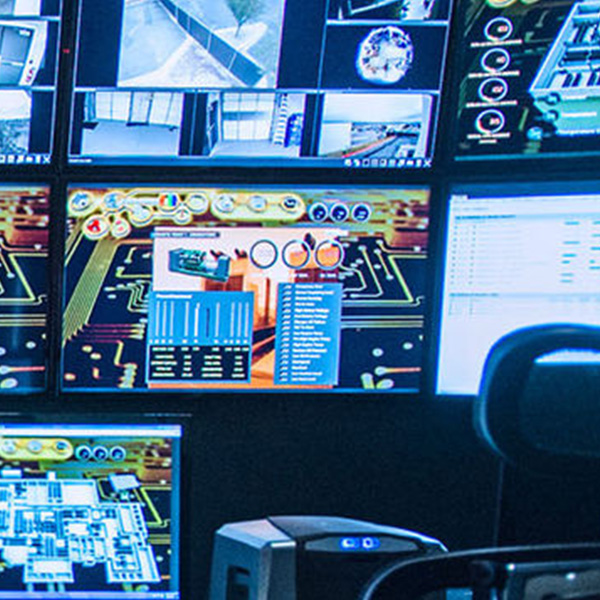
For today’s multi-site organizations with geographically dispersed locations, there is rising pressure for reliable long-range networks to support increased bandwidth needs and enhance security surveillance systems. This distributed operational model requires thoughtful infrastructure planning to meet stringent standards and harsh application environments, while keeping an eye on enabling future growth. A key element of surveillance modernization is a centralized command center where each system component (long-range fiber networking, industrial-grade hardware, high-definition cameras) can be monitored in real time.
As businesses and organizations continue to navigate rising security expectations and increasingly distributed operations, legacy technologies and aging equipment are failing to provide the foundation needed to keep pace with demands. Organizations are increasingly looking to replace or upgrade their surveillance infrastructure as scalable and resilient surveillance systems have become a necessity for operational excellence.
Common Challenges Driving Upgrade Needs
In our modern digital age, distributed site operations with staff and labor constraints, along with heightened security risks at the perimeter (such as parking areas, entrances and ATMs or other high-traffic points) are pushing organizations to rethink legacy surveillance technologies and transition to standardized, central command center. Teams need network infrastructure that can reliably transmit high-quality video over long distances, support high-definition Power over Ethernet (PoE) cameras, and withstand extreme temperatures and outdoor exposure – all while providing continuous uptime.
Blueprint for Modernization
These challenges demand a comprehensive long-range surveillance solution that leverages equipment with industrial-grade durability. To monitor the targeted perimeter environments, an effective architecture typically includes:
Plan your fiber optic cable backbone
Utilizing Layer 2 aggregation with SFP switches (and optional SFP+ uplinks) establishes reliable long-range communication with centralized fiber connections to carry video from each branch location back to the central command center. Further, opting for additional throughput via SFP+ ports can offer a strategic position to ensure long-term scalability; allowing an organization to increase bandwidth or integrate new technologies down the line without replacing its foundational hardware.
TRENDnet’s fiber solutions enable stable and high-speed connectivity across distances of up to 24.8 miles (40 km) for SFP modules, and 49.7 miles (80km) for media converters.1
Integrate industrial-grade access points and media conversion
At each distributed location or endpoint, industrial-grade SFP-to-Gigabit PoE++ media converters paired with industrial fiber SFP modules should be housed in rugged outdoor networking enclosures. This configuration extends reach and protects the equipment from harsh environmental conditions and temperature-related failures.
TRENDnet’s industrial lineup includes sealed, outdoor-rated networking enclosures with integrated power, further simplifying installation by eliminating the need for separate power supplies.
Map PoE cameras to perimeter for future-proof security
High-definition, PoE fixed turret cameras simplify cabling by delivering both power and data over a single Ethernet cable while delivering wide coverage for exterior areas. When PoE is mapped to the edge, it also provides leeway for mixed-device applications in future upgrades.
TRENDnet's HD fixed turret PoE cameras offer the flexibility and image clarity essential for capturing expansive outdoor spaces while maintaining situational awareness both day and night.
Centralize monitoring and management
With reliable long-range infrastructure in place, organizations can consolidate visibility and operations at a central command center while preserving local resilience at each site location. Planning for a phased transition by upgrading priority sites and cameras first helps to maintain business continuity and optimize system design and functionality throughout the migration.