ARTICLE
Safety in the Data Center: Risks, Solutions and Best Practices
By Shawn Gregg | January 26, 2026
Read Time: 5 Minutes
As artificial intelligence accelerates the growth of data centers, ensuring employee safety has never been more critical. These facilities operate around the clock and house high-density electrical infrastructure, specialized equipment, and complex cooling systems—all of which introduce unique hazards. A proactive approach to safety protects workers, minimizes downtime, and ensures compliance with stringent regulations.
Electrical Hazard Prevention in Data Centers
Electrical systems are the backbone of every data center, but they also pose significant risks. High and low voltage equipment, overloaded circuits, and human error can lead to arc flashes or electric shocks. Even routine maintenance can expose workers to dangerous energy levels.
Best Practices:
- Establish a baseline of electrical hazards and minimum expectations for employees when working with or near both energized and de-energized equipment.
- Conduct routine electrical inspections (in accordance with OSHA 29 CFR 1910 Subpart S and NFPA 70E requirements) to identify hazards before they escalate.
- Use certified components and implement load balancing to prevent circuit overloads.
- Provide electrical safety training, including lockout/tagout procedures, to ensure safe work practices.
- Install redundant power systems to minimize downtime during faults.
Wesco solutions: electrical safety PPE, lockout/tagout products and training, facility ID and signage/labeling, dielectric rubber goods and testing, electrical insulating tools, ESD matting
Data Center Fire Risk Mitigation
Servers and batteries run continuously in data center environments, generating heat and increasing fire risk. Flammable materials and dust accumulation due to underperforming HVAC systems can compound the danger. It’s important to take steps to prevent burns, equipment damage, and costly outages.
Best Practices:
- Perform routine comprehensive risk assessments focused on HVAC and fire safety.
- Ensure all flammable and/or hazardous materials are properly stored in NFPA flammable storage cabinets.
- Maintain and test fire suppression systems, including fire extinguishers and emergency lighting/evacuation procedures, to ensure readiness.
- Train staff regularly through fire drills and emergency response programs.
Wesco solutions: fire extinguishers, flammable storage cabinets, fire alarms, smoke detectors, flame-resistant clothing, emergency response training
Data Center Noise Hazards
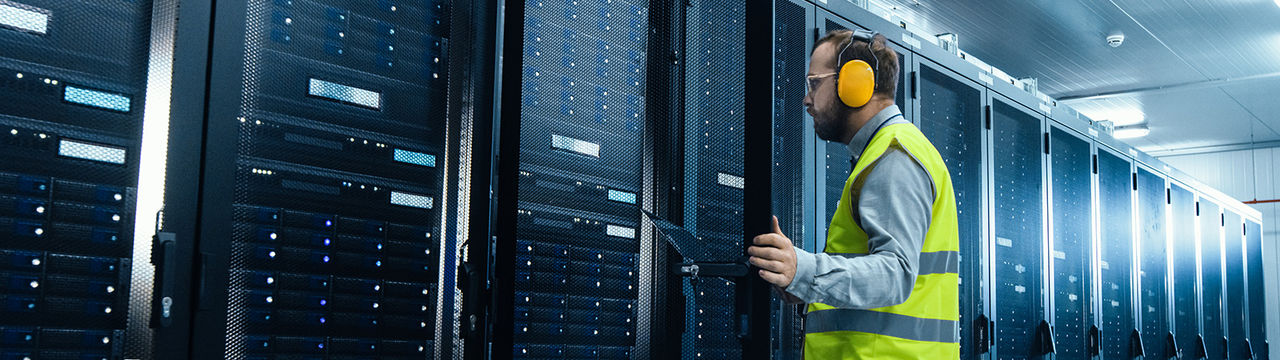
The constant hum of servers, fans and cooling systems creates a noisy environment that can damage hearing over time. Prolonged exposure greater than 90 dBA over an 8-hour work period may lead to permanent hearing loss.
Best Practices:
- Conduct noise assessments to monitor sound levels. Start with an area sample to determine if a certain work area is greater than 85-90 dBA. If so, a more formal study will need to be completed to determine an 8-hour time weighted average (TWA) and whether a formal hearing conservation program must be implemented.
- If a hearing conservation program is required, a baseline audiogram per employee is required within 6 months of employment for those exposed to the applicable work areas.
- Reduce or eliminate the noise level in work areas above the permissible exposure limit (PEL). If you cannot eliminate, provide hearing protection PPE to provide an effective noise level reduction (NLR).
- Conduct annual audiograms by a certified audiologist to ensure there is not a standard threshold shift greater than 10 dBA and the controls remain effective.
Wesco solutions: hearing protection PPE, hearing conservation services, acoustic measuring devices including dosimeters and sound level meters
Heat Hazards From Data Center Equipment
Continuous equipment operation generates substantial thermal energy, and cooling failures can cause heat stress. Workers exposed to high temperatures risk dehydration and fatigue, but there are precautions that can be taken.
Best Practices:
- Monitor temperature and humidity with sensors.
- Ensure proper ventilation and cooling systems.
- Supply cooling PPE and hydration stations.
- Schedule regular breaks to prevent heat-related illness.
Wesco solutions: heat stress and cooling products, heat stress monitoring devices, hydration products and solutions
Selecting the Right Hand Protection
Data center workers may encounter sharp edges on server racks, cable trays, and tools, which can lead to cuts and abrasions. Electrical systems add another layer of risk, with the potential for shocks during installation and maintenance. Chemical exposure from cleaning agents or battery handling further increases the danger, making proper protective measures essential.
Hand Safety Best Practices:
- Select gloves tailored to specific tasks, such as cut-resistant, electrical insulating, or chemical-resistant.
- Inspect PPE regularly and replace as needed.
Wesco solutions: cut-resistant gloves, crush-resistant gloves, electrical insulating gloves, ESD (static dissipative) rated gloves, nitrile gloves, general work gloves
The Importance of Eye Protection
During installation and maintenance tasks, workers may be exposed to flying debris or chemical splashes from cleaning agents. Fiber optic tasks add another risk, as laser light and accidental UV exposure from certain equipment can harm eye health without proper protection.
Eye Safety Best Practices:
- Conduct hazard assessments and select appropriate protection.
- Train staff on proper PPE use, including cleaning and storage of products.
- Choose gear that balances comfort and visibility.
Wesco solutions: safety glasses, goggles, face shields, prescription eyewear
Data Center Safety Signage
Safety signage is essential for preventing accidents, guiding emergency response, and meeting compliance standards in data centers. It directs personnel away from live electrical areas, shows required PPE, marks emergency exits, and identifies restricted zones.
Best Practices:
- Conduct facility identification and signage assessment.
- Place signs at eye level in unobstructed areas.
- Use color-coded cues for quick hazard recognition.
- Audit signage regularly and train staff on its meaning.
Wesco solutions: high-visibility signs, digital signage, pipe marking signs, custom labels and tags, signage audit services
Additional Hazards
Data centers pose multiple safety hazards, from ergonomic and chemical risks to respiratory issues and fall dangers during maintenance work.
Best Practices:
- Provide anti-fatigue and/or ESD mats and ergonomic (anti-sparking) tools.
- Train employees on safe lifting techniques.
- Use fall protection gear for work at heights.
Wesco solutions: safety training services, fall protection equipment, matting products and services
Comprehensive Safety Approach
Wesco offers end-to-end safety solutions for data centers, including program development, site audits, customizable training, connected safety technologies, PPE assessments, and emergency planning. Our partnerships with leading suppliers ensure access to best-in-class products and services.
Regulatory Compliance
Data centers must adhere to NFPA 70E, 75, 76, 101, OSHA 1910, and local codes. Regular documentation, training and audits are essential for compliance and worker safety.
Conclusion
Safety in data centers is a multifaceted challenge requiring vigilance and a systematic approach. By leveraging Wesco’s comprehensive solutions to address electrical, fire, noise, heat and ergonomic hazards, organizations can protect their workforce, maintain compliance, and ensure uninterrupted operations.


ABOUT THE AUTHOR
Shawn Gregg, Vice President of Global Safety
Shawn Gregg joined Wesco in 2023, bringing over 30 years of industrial safety market knowledge and technical expertise. Gregg started his career as a safety engineer and has remained dedicated to producing and delivering safety solutions that keep workers safe.
You might also like
-
The Rise of “Construction-Ready” Supply Chains: A New Model for Data Center Build Speed May 11, 2026 In this EC&M feature, Wesco and Eaton share a new model for speeding data center builds by reducing risk and improving gray space execution.Article
-
Solving Data Center Development Challenges April 14, 2026 Discover key data center development challenges and how Wesco supports data center power requirements and supply chain considerations to keep projects on track.Article

-
Q1 Construction Industry Report — North Central March 23, 2026 Read the Q1 Construction Industry Report — North Central to learn the latest trends, challenges and growth opportunities for the region.Article