

ARTICLE
A Digital Twin Is Only As Good As Its Data
April 10, 2026
Read Time: 2 Minutes
Digital twins evolved far beyond traditional 3D models. Today they’re expected to support smarter decisions across the full lifecycle of a building or campus. But when the data behind a digital twin is inaccurate, even the most sophisticated model becomes unreliable for real-world facility management.
Why Digital Twins Can Fall Short in Facility Operations
Traditional digital twins faltered at the handoff between construction and operation because they weren’t built on a foundation of continuously synchronized, operational data. Without that baseline of validated data, the “twin” stops reflecting what’s actually happening in the facility, making it useful for documentation, but far less useful for day-to-day operational decision-making.
How Centralized Facility Intelligence Strengthens Accuracy
This white paper explains how centralized facility intelligence can serve as the operational core of a digital twin – aggregating, normalizing, correlating and validating data from across the built environment to create a more dependable, real-time operational view.
What You’ll Learn in the Full White Paper
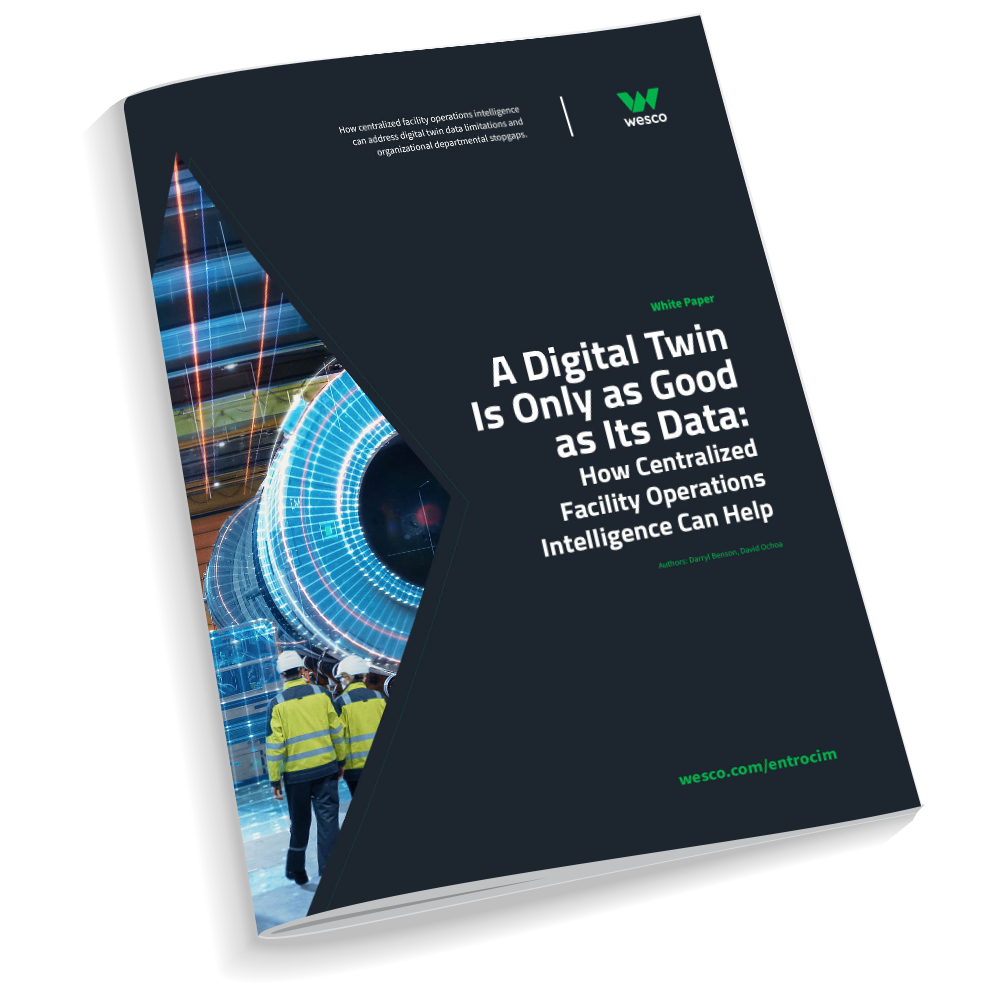
Inside, you’ll explore the evolution of digital twins, how centralized facility intelligence supports digital twin accuracy, dual implementation opportunities for smart facilities and how a unified intelligence layer can drive business and operational outcomes.
You might also like
-
entroCIM Delivers Smart Building Optimization for Global HQ October 2, 2025 Learn how a global HQ campus enhanced facility management operations across 2.5M sq. ft. using Wesco’s entroCIM platform to deliver smart building performance with a secure, cloud-hosted and adaptable centralized platform.Case Study
-
Scale Smart Facilities Capabilities With entroCIM August 26, 2025 Learn how the entroCIM platform helped a real estate developer streamline smart facilities technology deployment across multiple projects with open architecture and expert consulting.Case Study

-
Unify Facility Utility Management Systems with entroCIM July 9, 2025 A global automotive manufacturer modernized its legacy utility data management system by replacing it with entroCIM. The new platform unified data across 200M+ square feet of facilities, automated reporting and billing and enabled real-time insights for production benchmarking and efficiency.Case Study